One of the stereotypical things that ‘PhD students do’, according to a recent study,[1] is to talk about things that interest them with other people who share that interest. What better way to start this chronicle of my PhD experience, then, than with a report from a conference?
As might be expected given its age, Cambridge is home to a great many talented medievalists: in medieval French studies (my area of interest) alone, I’ve had the privilege of being taught by Miranda Griffin, Bill Burgwinkle and Sylvia Huot during my years as an undergraduate. ‘In between’ the undergraduates and the staff, though, it also has a very strong postgraduate community, which in 2014 founded its own reading group, Approaching the Medieval. This year, they organised their first conference, based around the theme of LIMITS. Since I’m very interested in the methodological questions invited by this topic – where does ‘medieval studies’ begin and end, after all? – I decided to take the plunge and submit a proposal; in non-jargon, a short piece addressing what my paper would seek to do do. If you’re interested, you can read it here.
Writing an proposal is something of a unique challenge, and to be honest, it still isn’t a process that I’m completely comfortable with. I recently had a very illuminating conversation with a colleague in France, during which she informed me that the Anglo-Saxon model of submitting a 250-word ‘proof of concept’ was far less common on the Continent; instead, it was (and is) far more usual to send in much longer pieces. Why, then, is condensing your paper down to such an extent fast becoming the norm for UK conferences? The answer to this question, I think, lies somewhere between practicality and process. Obviously, for conference organisers, reading and selecting from thirty submissions is much easier if each submission fits on one side of A4, but there’s also a genuine benefit for the person writing the paper. Even if the paper itself isn’t finished (or even, in some cases, developed at all beyond some half-formed ideas in your head), crystallising your main idea(s) into a short-form piece is an excellent way to guide your future writing process, and to give the conference organisers a clear sense of where you will be going.
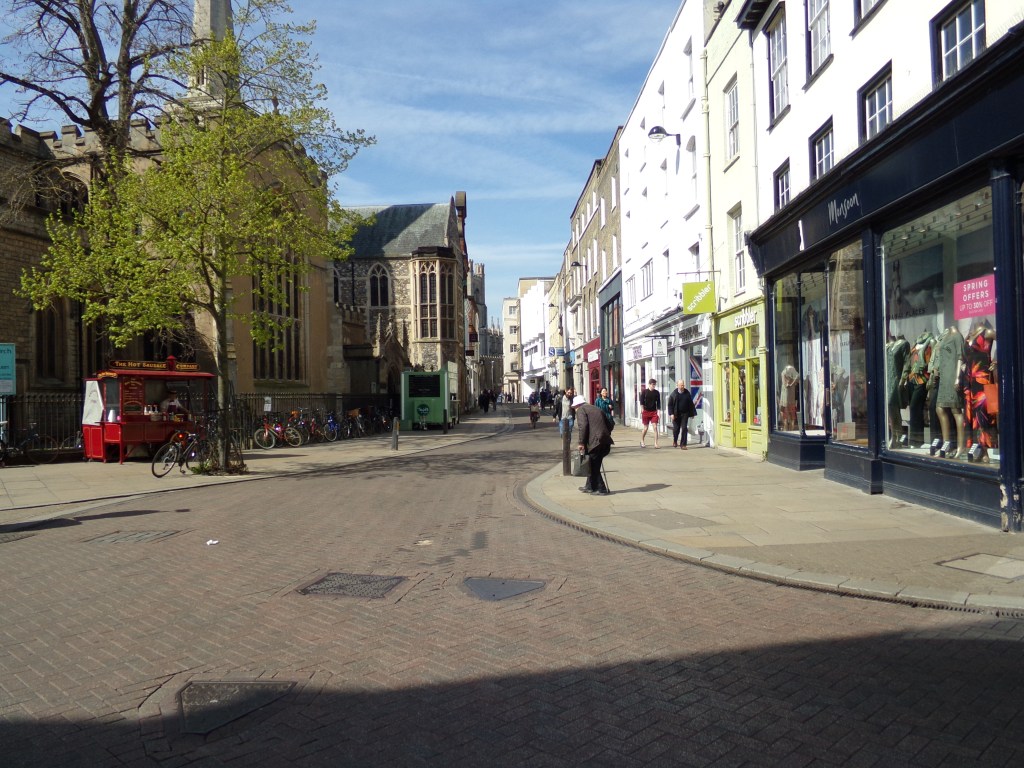
There is, of course, some room for flexibility in proposals: no-one’s going to sue you under the Trades Descriptions Act for changing your subject slightly. Thankfully for me, though, it appeared that my proposal served me well — sufficiently specific to give me concrete ideas for analysis and with enough wriggle-room to explore new directions — and before I knew it I was heading back from Lyon, making last-minute adjustments to my presentation and trying not to miss my connection at Lille Europe. Two more train journeys later, and I was in Cambridge, and spent the evening before the conference catching up with a Glasgow PhD student, Debbie White; we’d only ever ‘met’ on Twitter before, and I can confirm that she is just as cool in real life as she is online. It was a similar pleasure to meet Tim Wingard the following morning at the conference, whose own blogging (on medieval bestiaries) is far better-informed than these attempts on my part.
For a full rundown of the conference itself, I’d recommend that you have a read of the Storify, compiled from Tweets by myself and other colleagues. Broadly, though, it’s fair to say that the theme that the organisers had chosen — ‘limits’ — served the conference very well indeed. We were treated to a wide variety of papers from across the disciplines of medieval studies, including literary studies, history, theology, and art history. One particular highlight was Robert Mills’ keynote, intriguingly entitled ‘How to do things with fur’: Mills (no relation) used fur and animal skin more generally to broaden our understandings of what it meant to be ‘human’ in the European Middle Ages, and left us all with a great deal to think about in terms of how to ‘read’ these objects. My own panel was perhaps the most interdisciplinary of the lot: based around the idea of medievalism and modernity in dialogue, the three of us who were presenting took the opportunity to stretch the boundaries of medieval studies and to ask questions of how we both use and see this problematic period.
My presentation was based around one particular way of ‘using’ the Middle Ages: as a teaching tool. Throughout the past year, I’ve been using medieval English, and the theme of medievalism more broadly, as part of my advanced-level course in modern English expression for non-native speakers, an apparent contradiction that my paper tried to explain. Why does medieval studies, seemingly so far away from the concerns of today’s EFL students, function so well as the foundational element for a language course? If you’d like to see one possible answer to this question, I warmly invite you to watch my presentation, which you can do here. I’m also planning on writing a little more about it in the near future, developing on certain examples that I raised as part of the piece.

Conferences are funny things: as an outsider looking in, it can often seem as if they’re somewhat heavy on navel-gazing and light on ideas. As I’ve started going to more and more conferences, though, I’ve begun to develop my own way of thinking about them. For me, the best conference presentations are themselves works in progress: the value of a conference paper is not in showing everyone how clever you think you are, but rather in getting feedback on your ideas from experts and interested parties which you can yourself take on board later. This was why I found the question-and-answer session with my fellow panellists so valuable, as we were asked probing (but genuinely useful) questions about our methodologies, our aims, and the possible restrictions of our individual approaches. Conferences let you make connections: connections between your own disparate ideas, connections with other avenues of research, and connections with other people who share your interests. If this particular conference is anything to go by, I’m already looking forward to the next one.
1 Edward Mills, ‘Things PhD students do: a recent study’, Explorations in Invented Statistics, 42 (2016), 123-45. Sample size (N) = 1.[↵]
 Edward Mills
Leave a comment