A fair chunk of the Sunday before last was spent reading. Much to my shame, this is something that I can’t say nearly as often as I’d like – the flashy lights of the Internet have definitely had some kind of effect on my cerebral cortex in this respect – but I was relieved to discover that, given the excuse, I can still find a great deal of enjoyment in a good paperback. In particular, I’ve always been a fan of non-fiction, and with the PhD starting soon I decided a few months ago to investigate what I should expect upon becoming a research student.
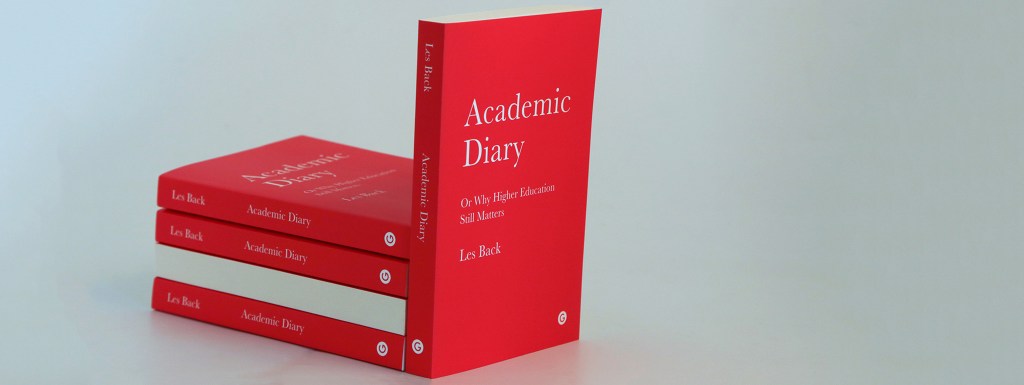
With that in mind, I’ve been spending time recently with a new book from the newly-launched Goldsmiths Press. Les Back, a lecturer in sociology at Goldsmiths, has been writing and curating his own observations on academic life for decades, and they have at last made it into print form after first seeing the light of day on the Internet.
When reading Back’s observations on the university and its machinations, it’s difficult not to think of Mary Beard, whose own blog on the subject has itself been the impetus for two books. Like Beard, Back is an insightful commentator, whose years of experience in the university have clearly played a role in forging his strident defenses of the university as a place of learning:
‘Universities are at their best when they are places where minds are allowed to wander, be it through the labyrinth of high theory or in the lowly task of making the familiar strange […] it seems important to stop being afraid of arguing for the vocation of thinking.’[1]
His comments on the institution of Goldsmiths itself are particularly illuminating. In telling the story of Richard Hoggart, the Warden at Goldsmiths when he first arrived there, Back dwells approvingly on the ‘intense vitality’ of the place.[2] The philanthropic origins of Goldsmiths have clearly left their mark on Back, whose affection for the founding values of the place shine through. Libraries are offered a similarly spirited (and, if I may say so, inspired) defense. These ‘places of serendipity’, as Back calls them,[3] distinguish themselves from Google by offering the potential for random discovery: such a visit from the ‘Library Angel’, aided and abetted by the browsing-friendly classification of the Dewey Decimal System, makes them truly unique and invaluable. Reading this chapter, I couldn’t help but be reminded of the adage about (public) libraries that Back himself would most likely approve of: they are, after all, one of the last places on the high street that don’t ask for your money in exchange for the right to spend time there.
Back is perhaps at his best, though, when he dwells on the more specific, and to some more quotidian, aspects of academic life. I confess to having felt more than a small spike of empathy upon reading the words ‘I have always had a weakness for a nice pen’, followed by an urge to laugh out loud at the notion that we ‘fetishise the tools of our trade.’[4]
His own commitment to outreach and to taking his field of research into schools and prisons is admirable, as is his frankness with the student who asks him how much he is paid;[5] the following chapter, ‘Bourdieu behind bars’, is an equally lucid testimony to the power of ideas and to the fabulous work carried out though the Open Book scheme.
Back writes with the knowledge and insight of someone who has spent years within with the university system, and the passion of someone who has spent a fair part of that time defending it. Ever since finishing Academic Diary, I’ve been continually drawn to it, and have a feeling that somehow it will shape my own understanding of the system around me as it develops. I could easily recommend each individual chapter to a different person at a different time, but the book as a whole deserves to be read and appreciated as a whole. Structured around the concept of the academic calendar, with each chapter concurrent to a different point within it, it enlightens and entertains in equal measure as we are led through the whirlwind of the university year. Back acknowledges the ‘renewal’ inherent every autumn term:
‘Every September marks the beginning of another year. Jay Parini says that academic life is renewed with the fall of autumn leaves, ‘shedding the previous year’s failures and tossing them out of the window like so much confetti’. It is a time to plan the year ahead. The academic diary is also a navigation device, a compass ensuring – as far as possible – that we are in the right place […] at the right time.’[6]
I certainly recognize something in these interpretations surrounding September: even now, the smell of autumn mornings has a very particular effect on me. The relationship between each academic year and the diary it represents, though, deserves its own study; for that, and for my own personal relationship with the academic diary, we’ll have to wait until next week.
Cover image (C) Goldsmiths Press.
1 p. 214 [↵]
2 p. 27 [↵]
3 p. 199 [↵]
4 p. 134 [↵]
5 p. 82 [↵]
6 p. 1 [↵]
 Edward Mills
Leave a comment