
Between start-of-year meetings with supervisors, the arrival of the freshers, and the rush to finalize conference paper proposals, it’s been a busy first few weeks back in Exeter. In the midst of all of this, though, I’ve also had one amazing opportunity that really deserves a blog post all to itself. I’ve mentioned before on this blog how wonderful my supervisory team are, in terms of both their interest in my research and their eagerness to involve postgraduate students in the broader life of the Department here at Exeter. In this case, it was my second supervisor who offered me the opportunity, and it was one that I simply couldn’t turn down: ‘Edward, would you like to come along and watch the digitisation of the Exeter Book?’
Perhaps a little explanation is in order here. The Exeter Book is remarkable, even by the standards of medieval manuscripts: it’s one of only four codices containing Anglo-Saxon poetry to have survived to the present day, and as such is of great interest to scholars of both the history of the English language and to Old English culture more generally. It’s held by the Cathedral Library and Archives here in Exeter, but until now has not been digitised, with only the 1930s facsimile edition being available to scholars. A full digitisation of a manuscript can never replace an in-situ visit to the original, of course, but it is nevertheless an invaluable resource, making features such as page layout, scribal decisions and illuminations visible to scholars from around the world. Institutions such as the British Library have led the way in the task of digitising their collections, often through named projects such as the Polonsky England and France Project for pre-1200 material, while a quick glance at a database such as the Digital Medieval Manuscripts App demonstrates that smaller libraries around the world are following suit. Even more excitingly, a huge amount of fascinating work is being done that draws on the availability of high-resolution digital images: DigiPal and the Roman de la Rose Digital Library, to name but a few such projects, are doing work that simply wouldn’t have been possible twenty years ago.
But where does the Exeter Book fit into all this? As it happens, one of my supervisors has a long-standing research project based around bringing medieval manuscripts out of dusty archives and Special Collections reading rooms and into the public sphere. As one of the most iconic manuscripts in the world, the Exeter Book plays a key role in Emma Cayley’s Exeter Manuscripts Project, which has been running since 2012 and which has been attracting an immense amount of media interest. This week, it was finally time for a moment that Emma herself had been waiting for since 2012: the first full digitisation of the Exeter Book, opening it up for exploration both from specialists and from the broader public.[1] Being the lovely supervisor that she is, she invited me along to watch.
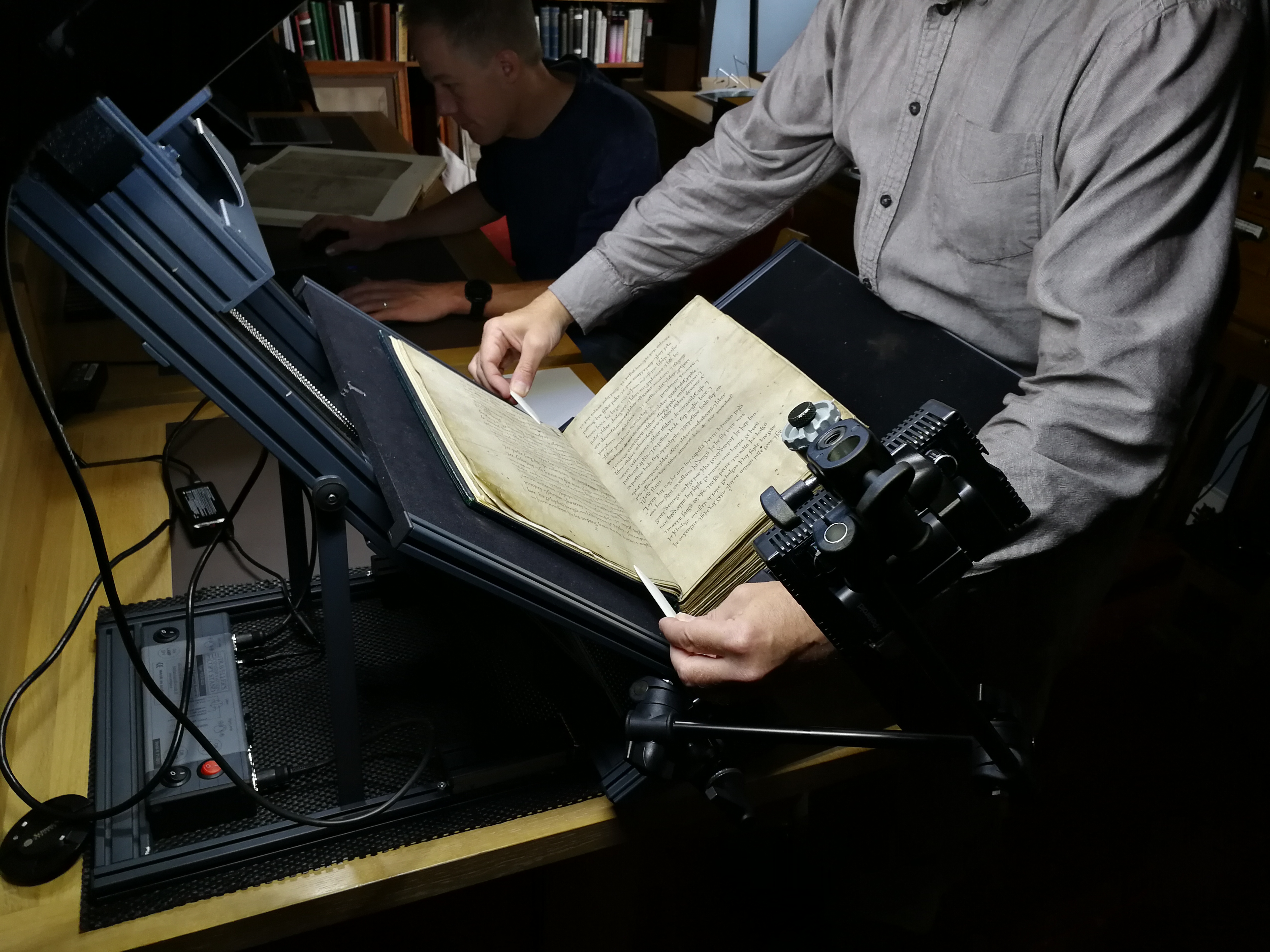
I’ve been using digitsed manuscripts in some form or another for a few years now, but until yesterday I’d never been able to observe a digitisation actually being carried out. Thankfully, the staff at the Cathedral Archives and the University’s own Digital Humanities team were extremely welcoming, and even allowed us to take a few photos to provide some insight into how the process works. This image offers a snapshot of the entire process: the manuscript is placed in a cradle and held in place with delicate tools before an image is captured of it, checked against the existing facsimile, and given a folio number.

It might seem surprising, in a world where the technology and the hardware to scan documents is ubiquitous, that the method employed in digitisation should be so low-tech. On a fundamental level, after all, the team are just taking a photo of the manuscript with a camera, then turning a page and repeating the process again. You can just see the camera in this photo, in fact: it’s mounted on top of the frame, above the beam lights. In reality, of course, this ‘back-to-basics’ approach has some serious conservation science behind it: harsh light such as that used in photocopiers could do lasting damage to the delicate pigments in the ink, as well as reflecting off any illuminations and thus ruining the image output.
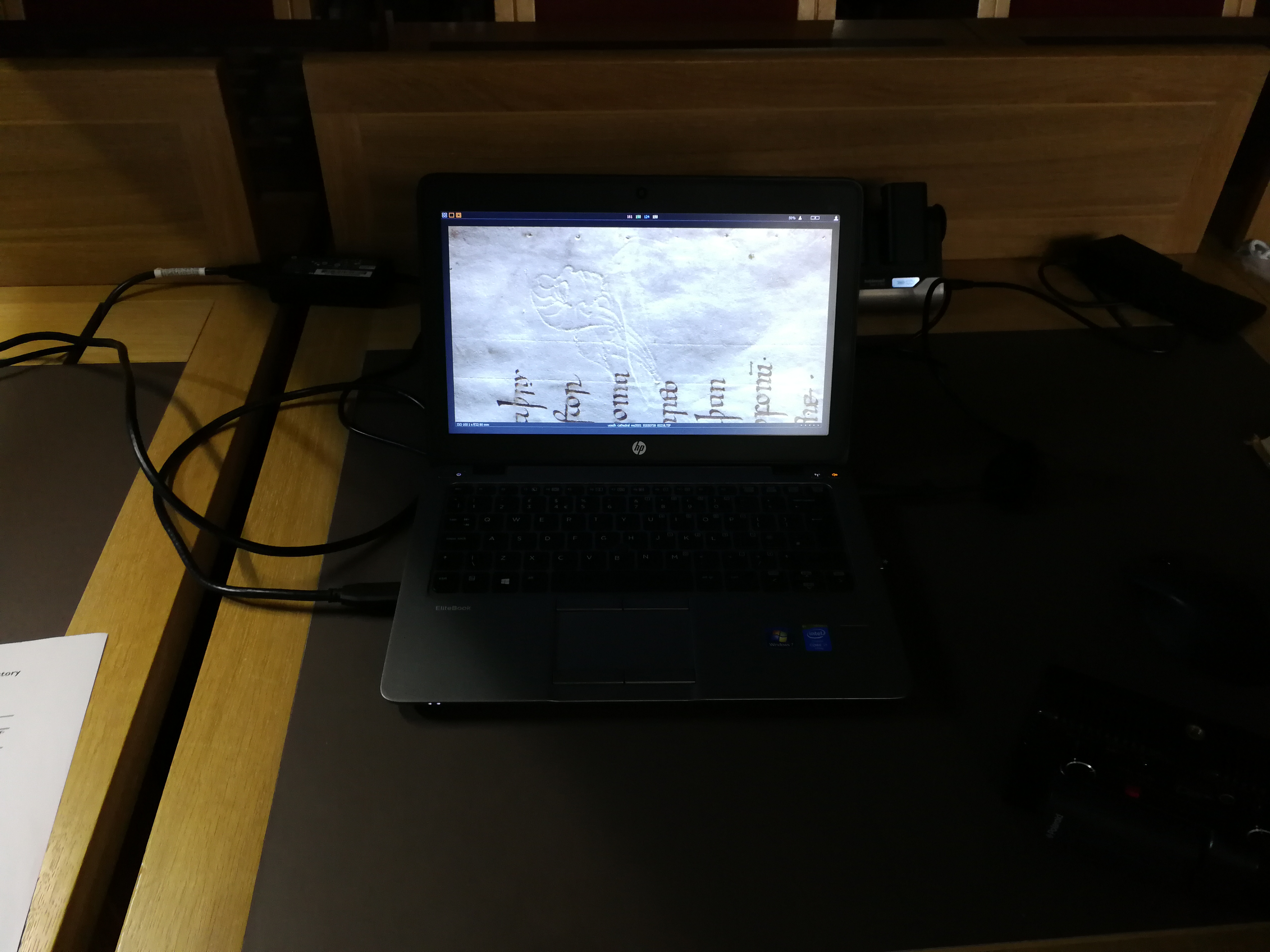
There’s another benefit, though, to using a (very high-resolution!) camera to undertake the digitisation: it allows for a great deal more control over the lighting conditions than a scanner could ever provide. The team were actually doing three ‘passes’ of the manuscript, each taken at a different exposure level; viewers of the images online will therefore be able to choose a setting for each page, potentially revealing information (such as erasures) that might only be visible in low or high light. The device nearest to me in the picture above is an extension of this idea a similar purpose: it’s called a ‘raking light‘, and is particularly useful for revealing subtle features such as dry-point decoration and ruling. The team found a good example of this early on in the process, when the raking light revealed a representation of what we believe to be the head of an angel. Whether or not this dry-point was intended to be colored in at a later moment, the fact that it was undertaken in the first place offers a valuable insight into the mindsets of both the Exeter Book’s scribes and its later users.
As you can probably tell, watching the magic of digitisation happen was nothing short of inspiring; this was an amazing experience, and it would be unthinkable to end this blog post without thanking a few people. Emma Cayley (on Twitter here) deserves a huge amount of credit for all the work that she’s put into this project, as do her colleagues, Elaine Treharne at Stanford and Johanna Green in Glasgow. The Digital Humanities team at the University of Exeter, headed by Gary Stringer, were kind enough to allow us to barge in and take photos, all while managing to retain their trademark composure and skill in the work that they do; and, of course, the Cathedral’s own Library and Archives staff made the whole project possible by acting as custodians of this wonderful fragment of le patrimoine. I hope this blog post has whetted your appetite for the digitisation to appear, which will happen in due course; I’ll be sure to keep readers of this blog up to date with any future developments.
For now, though, I must venture back into the world of Anglo-Norman didacticism; thankfully, I’m in good company, surrounded by scholars and enthusiasts described so accurately by one poem in the Exeter Book as ‘boceras / weorþað wisfæste‘. ‘Scholars / becoming fast in wisdom’, indeed.
[1] Edit: I have since been informed that there was in fact a previous digitisation of the Exeter Book, in the form of Bernard J. Muir’s DVD-ROM produced in 2006. ‘Fast in wisdom’, indeed! Since then, of course, the technology to publish and to share the digitisations has evolved considerably, and the high-resolution images taken over the past week will represent a significant development in our ability to study the Exeter Book as a complete manuscript. ↩

 Edward Mills
Leave a comment